The team had just launched a brand new homepage for their storefront. Marco, their Product Manager, high-fived each of the team members. The team reviewed their dashboard to monitor all the great comments coming in from users, content that all their problems had been solved by the new experience. The next three hours descended into panic for the team. Sales dropped by 55%.
The comment stream from the survey on the homepage contained many angry comments (some of which we couldn’t possibly publish in this book). Many users were complaining, confused about the need for the change. It turns out that most customers were not ready for this change – it came as a surprise, and they had become used to navigating the website in a certain way, even if it was suboptimal. Marco instructed the team to roll back the changes.
Often we see people just pushing product changes for the end-user, assuming everything will be great. The user may be happy with the services and features your product offers. Maybe not. When something changes in the product, most of time it is a surprise for the user; they don’t understand why. From our experience, one of the main reasons they may not like it is because they didn’t expect it. A lot of user dissatisfaction may come when the product changes, even more when the product reaches maturity and stability in its life cycle. At this stage, as we saw in the example, the expected outcome may not be met.
We know there is much pressure to release something to the market, however something needs to happen first. Remember: before you make two bottles of wine, make one, but well-made! Change management is arguably one of the most underemphasized elements of product development. A change management model such as Outcome-Driven Product Change Model can help on this.
Pattern: Outcome-Driven Product Change Model
“Outcomes are what your users do, say, and feel” – Jeff Patton
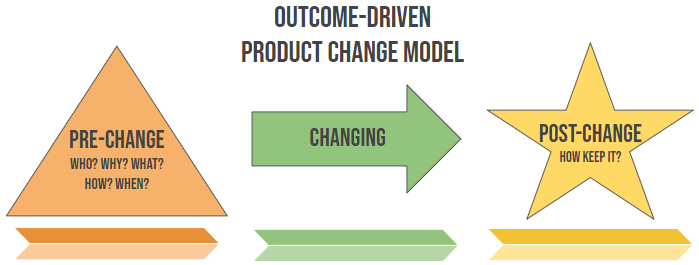
1) Pre-change
Setup the change. First of all, engage key-stakeholders and users in need of the positive behavioural change – the desired outcome. Be clear on what is going to be changed, who is being impacted and when exactly will be the moment of change. Prepare those about to experience the change with knowledge, materials, and training, in order for them to understand how the change will positively impact how they interact with the product.
2) Changing
It’s now time to deliver the change. If everything is well-prepared, changing the behaviour of the product for the end-user must flow easily.
3) Post-change
It’s time to enable the change to stick. Plan a set of actions which can be executed to monitor the outcome, and see if the change has been successful.
Quick Tip! Ps.: Feature toggles, Canary releasing and A/B testing are excellent technique to help introduct change gradually. Read more on Martin Fowler’s Site.
 The Third Stream Book