Every day, Team Maverick would have great discussions around their metrics dashboard. The developers were proud about how they could see real time data on how the features they created were being used. Their Product Manager, Barry, was well versed in data analytics, being a former developer himself. Team Maverick were proud of being known as the most data-driven team in the whole organisation.
One day, Barry shared back the most recent multivariate test results of a new shopping cart experience with Jane, the VP of Product. So confident was Barry that she would get resourcing for an extra team to build the new experience more quickly, he had a celebratory lunch booked for his team that afternoon. In Dublin’s finest steakhouse, Shanahan’s on the Green, no less!
At the end of Barry’s data shareback, there was stunned silence. “I don’t get it,” replied Jane. “Barry, you want another team, but all I see are dry numbers. I don’t get how this connects to our strategy for this year.” Sweat rolled down Barry’s cheeks, soaking his beard. He knew his presentation hadn’t resonated, and his ask was swiftly declined. Lunch was cancelled.
Pattern: Storytelling with data
So, what went wrong for Barry? He had shared the comprehensive results of a test, but didn’t get what he requested. He didn’t tell a story.
Data is great – but it is not enough. We must supplement the hard data with not only how it solves the users’ problems, but how it connects back to the product strategy. Our audience needs to understand what’s in it for them too, and be emotionally invested. We must be data-informed, and not data-driven.
To tell your story with data, we recommend Steven Pressfield’s storytelling framework from Nobody Wants to Read Your Sh*t. He refers to it as the 8 universal principles of storytelling:
- Every story must have a concept. It must put a unique and original spin, twist or framing device upon the material.
- Every story must be about something. It must have a theme.
- Every story must have a beginning, a middle, and an end. Act One, Act Two, Act Three.
- Every story must have a hero.
- Every story must have a villain.
- Every story must start with an Inciting Incident, embedded within which is the story’s climax.
- Every story must escalate through Act Two in terms of energy, stakes, complication and significance/meaning as it progresses.
- Every story must build to a climax centered around a clash between the hero and the villain that pays off everything that came before and that pays it off on-theme.
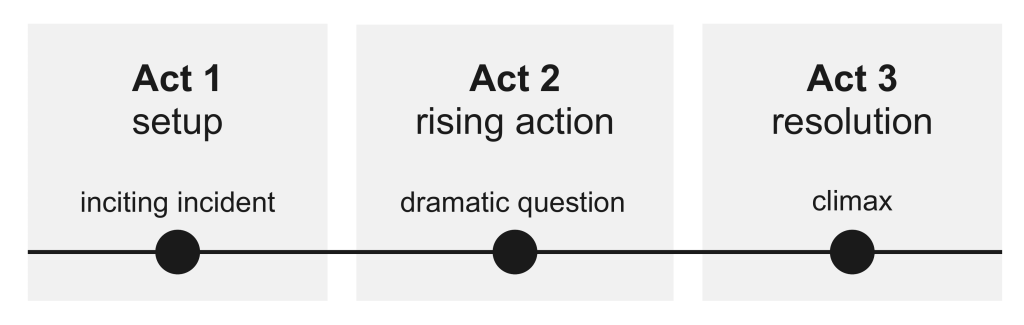
Alongside this, consider the classic 3-Act structure of a great story, below. You might have thought this was just useful for writing fairy tales or Hollywood blockbusters. But no – we can apply this structure as Product people to help with our narrative, using data to tell stories to our stakeholders and influence decisions.
You can use this as a template to tell your data-informed stories to make pitches to your stakeholders.
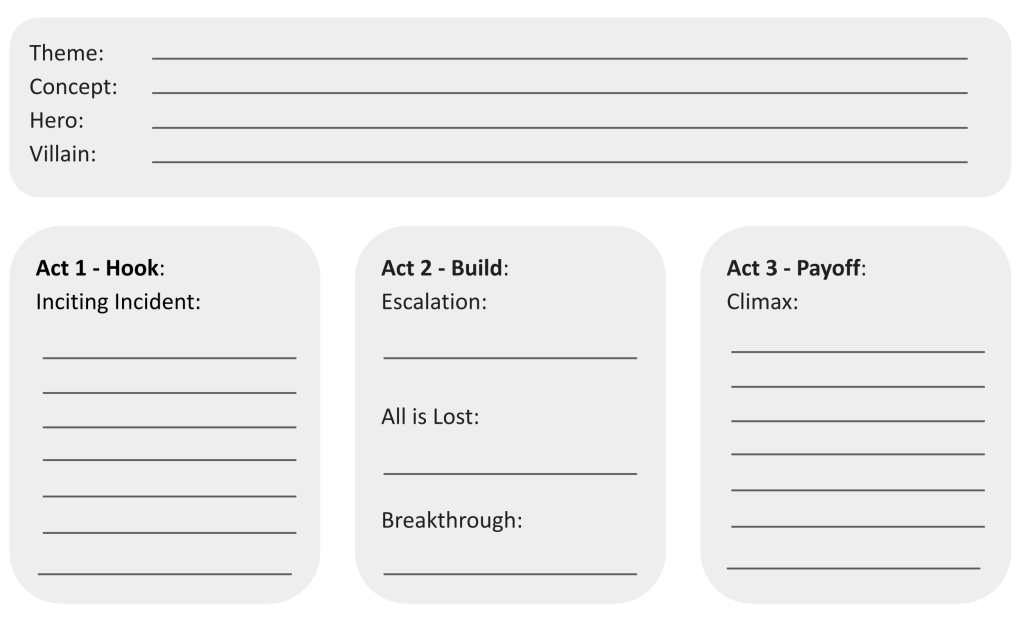
Example – The 1-click checkout pitch
- Theme: Frictionless checkout
- Concept: 1-click checkout
- Hero: Best in class user experience
- Villain: Friction
- Act 1 – Hook: This is our opportunity to decrease purchase time for our users by 25% & increase sales & satisfaction
- Inciting Incident: Our users have left us these terrible reviews in the app store and our competitors are moving ahead of us.
- Act 2 – Build: 3 years after launching our shopping cart experience, we are no longer best in class.
- Escalation: Our competitors are killing us with their user experience.
- All is Lost: Our Customer Impact Score for our store has dropped by 50% over the past year.
- Breakthrough: Our research has revealed if we don’t act now, we will lose more customers.
- Act 3 – Payoff: We have run multivariate testing on a new user experience and these are the results.
- Climax: We have the opportunity to full scale this & lead in the market. This is what we need from you…
This gives your narrative a structure, informed by data, but not data alone. In fact, we’ve used this template countless times for presentations, pitches, talks, speeches, etc. Use it wisely.
 The Third Stream Book