“We put some agile fairy dust in here and we’re so f***ing agile, it’s just awesome” – Klaus Leopold
Every day, in Team Fox’s team area the sound of a bell could frequently be heard between the time of 9.30am to 9.45am. Every time a user story moved to the team’s Done column on their board, the team rang a shiny brass bell. This was followed by a cacophony of applause. A few days later, in the team’s Sprint Review, the team heard great feedback from their internal business stakeholders about how much they loved the work on the latest user stories. Two months later, the team delivered their next major release, confident that their new feature would move the needle on user and business outcomes. The reality was this – it didn’t. In fact, bookings through the shopping cart decreased and user satisfaction score also went down!
What happened? All the indicators were positive. The team was doing Agile brilliantly – getting stories to Done every day, Standups on time, happy stakeholders. In his book “Rethinking Agile,” Klaus Leopold reveals an uncomfortable truth – Agile teams who are purely delivery focused have nothing to do with business agility – they need to shift right to focus on outcomes. We could be doing Purple Dinosaur Method at the team level and it would not shift business agility. What shifts business agility and thinking about outcomes is looking beyond the team level. This is where Kanban comes into play.
Pattern: Making the flow of outcomes visible
Imagine you’re flying to your favourite, far-flung holiday destination. As you take off, maybe you can see the cars and houses out your window. As the altitude increases, perhaps you can see small towns and cities. Then you reach 10,000 feet and on a clear day perhaps you can see your entire country. When we think of the Third Stream, we need to zoom out from the team level to see the bigger picture of the outcomes we are delivering.
We want to be able to identify opportunities for improvements from different altitudes. There are typically three altitudes, but there could be more depending on your organisation – they are usually:
- Strategy
- Value stream
- Product team
Sounds great, but does this work in practice for Team Fox? Well, firstly Team Fox are likely part of a value stream of other teams delivering the same product. These teams share similar outcomes, and these outcomes are inputs for higher level strategic impacts. They are delivering towards the product’s strategic goals.
Visualise the flow of outcomes using Kanban boards
Similar to how Team Fox has a Kanban board, we design Kanban boards at the value stream and strategy levels, populating them with features and strategic initiatives, respectively. We then supplement this with feedback loops to observe the flow, orient around what to, decide what to do and then act.
Team of Teams weekly meetings for outcome-focused interactions
Once per week, representatives from Team Fox meet with those from Team Cat, Team Dog and Team Tiger to review progress, using Value Stream Standup meetings.
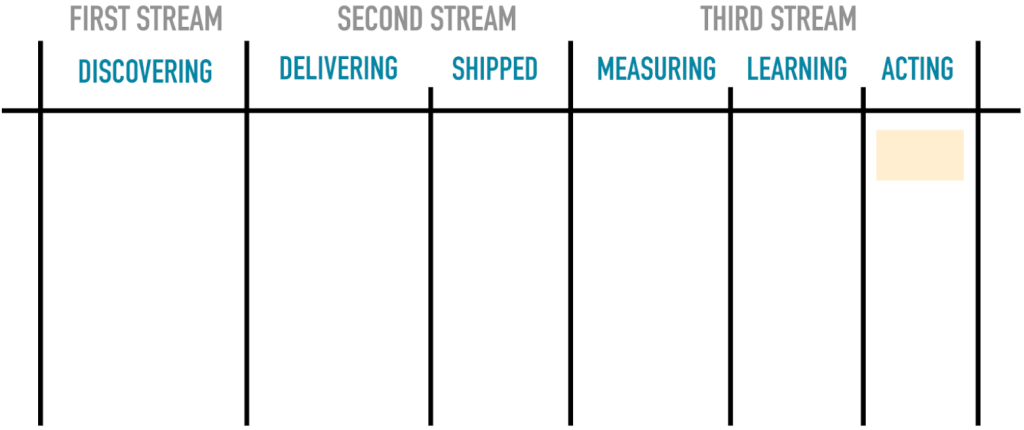
They “walk the board”, starting their Standup discussion at the far right hand side of the board. However, the column on the far right is not called “Done.” Rather, we start with the Third Stream columns: Measure – Learn – Act. We discuss what the latest feature and product data is telling us, what we have learned, and what action we need to take. Perhaps we need to kill a feature early based on the latest A/B test results, for example. This means we are reviewing this data every week, and taking action to course correct where needed.
Strategy Standups for impact-focused interactions
Once per month, leaders across the product meet using Strategy Standup meetings.
They “walk the board,” similar to the value stream teams. Again, we start with the Third Stream columns: Measure – Learn – Act. The discussion is centered around how their strategic bets are faring, and whether any pivots are required. Based on these discussions, they decide whether any updates to their strategy are needed.
As you can see, the Third Stream plays an important part when we are having agile interactions beyond the team level. Kanban is a useful practice to visualise and help build frequent feedback loops to understand how our outcomes and impacts are trending, and what action we need to take next.
 The Third Stream Book