“Product strategy is a system of achievable goals and visions that work together to align the team around desirable outcomes for both the business and your customers.” – Melissa Perri
The end of the quarter had arrived, and the senior leadership team for the SafeBrowse Antivirus product gathered for their final OKR Review of the quarter. They reviewed each goal in the form of their Key Results:
- Increase bookings from $3m to $10m by end of Q4
- Increase Customer Impact Score from 33% to 65%
Both KRs didn’t hit the mark. The leaders gazed agonisingly at the final results. Booking increased to $5m and NPS actually decreased to 25%. In spite of the motivational speeches they gave to the teams and the great verbal feedback they heard from customers at that golf outing the previous week, the strategy had not succeeded. How could they not see and act on this later? They were doing these OKR reviews every month, after all. What was causing bookings not to increase fast? What caused the Customer Impact Score to decrease?
Pattern: The product strategy review
What happened in the example is that the feedback loop between the lower level product outcomes and the higher level strategic goals had not been established. There were signals being missed every month from the outcome data the product teams were collecting. Perhaps the strategy could have been adjusted, and shifted from bookings to units, for example. Or perhaps a new initiative could have been swapped in to help increase customer satisfaction.
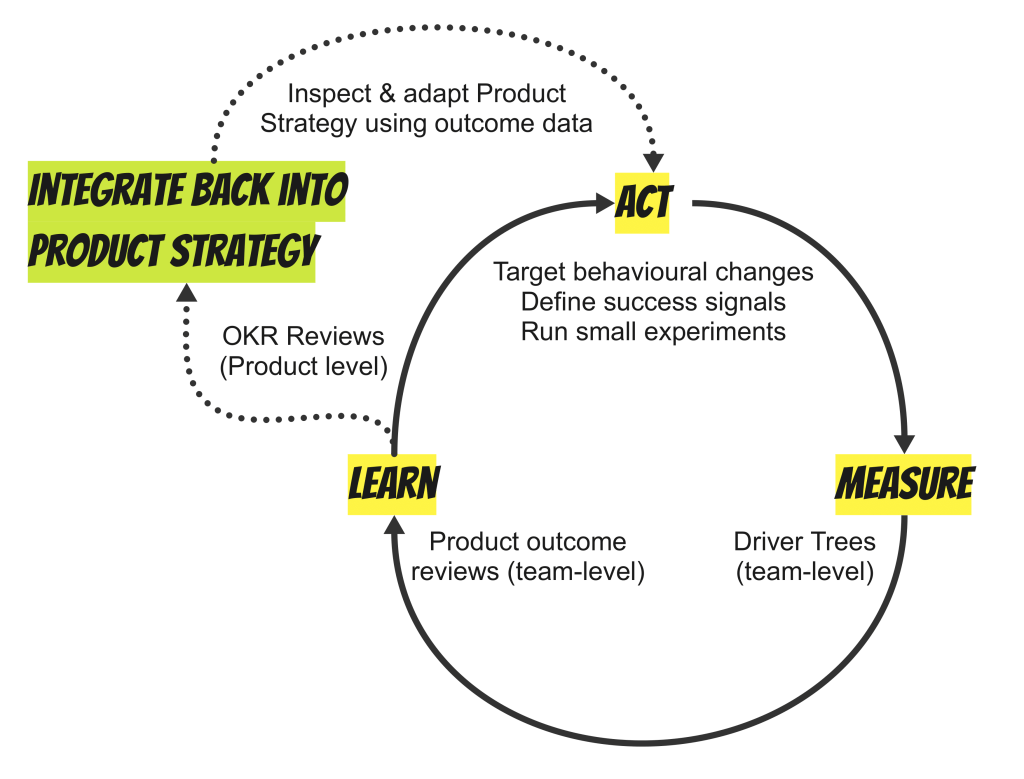
As we can see from Melissa Perri’s definition of product strategy, we are talking about how outcomes inform our path towards achieving our higher level product goals on our journey towards our vision (Melissa Perri, 2016). We are not talking about something wooly here, we are referring to those changes in human (users, customers) behaviour we described many times in this book. Therefore, when we do Product Strategy Reviews, we need to bring product outcome data from what the teams have shipped in for review. This should inform how we are trending towards those goals.
For example, if we are using OKRs as our goal-setting framework to deploy our strategy, then we should bring our Driver Trees into our monthly OKR review. We should then inspect what this data is telling us, and adjust our strategic goals accordingly. We are fans of OKRs, as it gives a nice framework to set those goals. However, this is just a framework – it’s purposely not complete, and needs to be supplemented with input data in order to know if we’re on the right path.
No matter what goal-setting framework you are using, the key is bringing this outcome data, set out by and collected by the teams, into understanding “are we achieving our higher level goals?”
 The Third Stream Book