“Ideas are easy. Execution is everything” – John Doerr
It felt like deja vu for Team Mars. They were approaching the end of another quarter, and there was a mad dash to pull together metrics for their OKRs. Dylan, the team’s lead developer, couldn’t even remember the OKRs the team had set at the start of the quarter. The OKRs they had set felt like a box-ticking exercise, as they had no connection to their day to day work. It was a routine they went through every quarter, so they could report up to senior leadership.
OKR (Objectives and Key Results) is a goal-setting framework used by organisations to define measurable goals and track their outcomes. The creation of OKR is attributed to Andrew Grove, who introduced the approach whilst working in Intel in the 70’s. Even though it is a simple approach to goal-setting, many companies struggle to successfully implement it.
A benefit of using OKRs for product development is to enable more outcome-driven approaches. Instead of “did we ship on time?” being the measure of success, we ask “did we shift customer behaviour to impact business results positively?” In the story, OKRs had become a box-checking exercise for Team Mars, and the OKRs they had set at the start of the quarter were a distant memory. They had become Zombies which came back to haunt the team every quarter.
Pattern: Bi-weekly OKR reviews
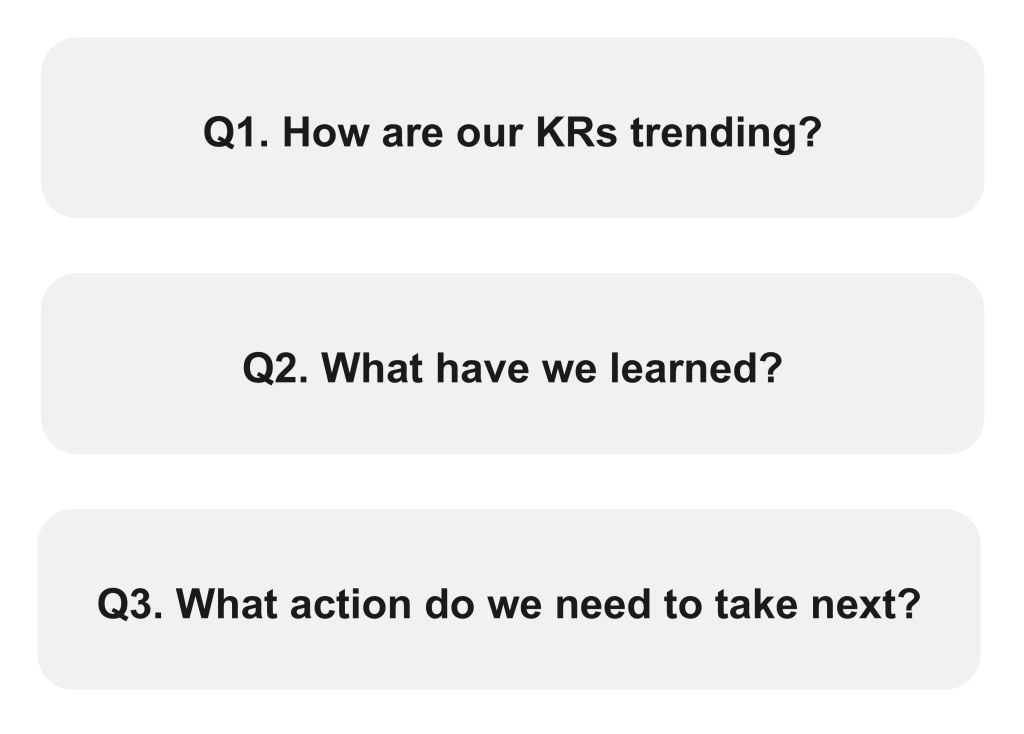
This is why we recommend scheduling regular OKR reviews. We recommend scheduling these every 2-4 weeks, or during the Sprint Review if you are using Scrum. By asking ourselves these three questions, we can understand how we are moving the needle on our Key Results:
These OKRs should tie directly back to a team’s product development work. If it feels like “the actual work” and “OKRs” are two separate things, then OKRs will become Zombies for you to deal with. Every epic or feature the team works on should relate back to a Key Result. By tying these two items together and reflecting on the outcomes regularly, the Zombies will be kept at bay.
Example
For Team Mars, their OKR Review could have looked like this:
- How are our KRs trending? – Cart conversion rate has increased by 3% over the past 2 weeks.
- What have we learned? – The new cart design is making it easier for users to progress to the payment page.
- What action do we take next? – Test the cart messaging to try increase conversations from 3% to 5% over the next 2 weeks.
 The Third Stream Book